Call for free estimate
Licensed & Insured
A mature tree can add shade, privacy and character to a Florida property for decades. But trees also change over time. Storms, decay, root problems, previous pruning and simple age can turn a tree—or one large limb—into a potential hazard.
Not every leaning trunk or dead branch means a tree needs to come down. The useful question is whether something has changed enough to justify a closer look. If you notice any of the warning signs below, especially near a home, driveway, power line or frequently used area, it may be time to have the tree professionally assessed.
Dead wood is one of the easiest warning signs for a homeowner to notice. A branch may have no leaves when the rest of the canopy is healthy, show peeling bark, appear brittle or remain hanging after it has broken.
In Southwest Florida, wind and heavy rain can turn weakened limbs into falling hazards. Dead wooding or selective pruning may be enough when the rest of the tree is structurally sound. The important part is addressing the problem before the next storm tests the branch for you.
Some trees naturally grow at an angle, and a long-standing lean is not automatically an emergency. A recent change is more concerning.
If a tree appears to be leaning more than it did before, look at the soil around the base. Raised soil, exposed roots or a root plate that appears to be lifting can signal instability. After a major storm, changes around the root zone deserve particular attention.
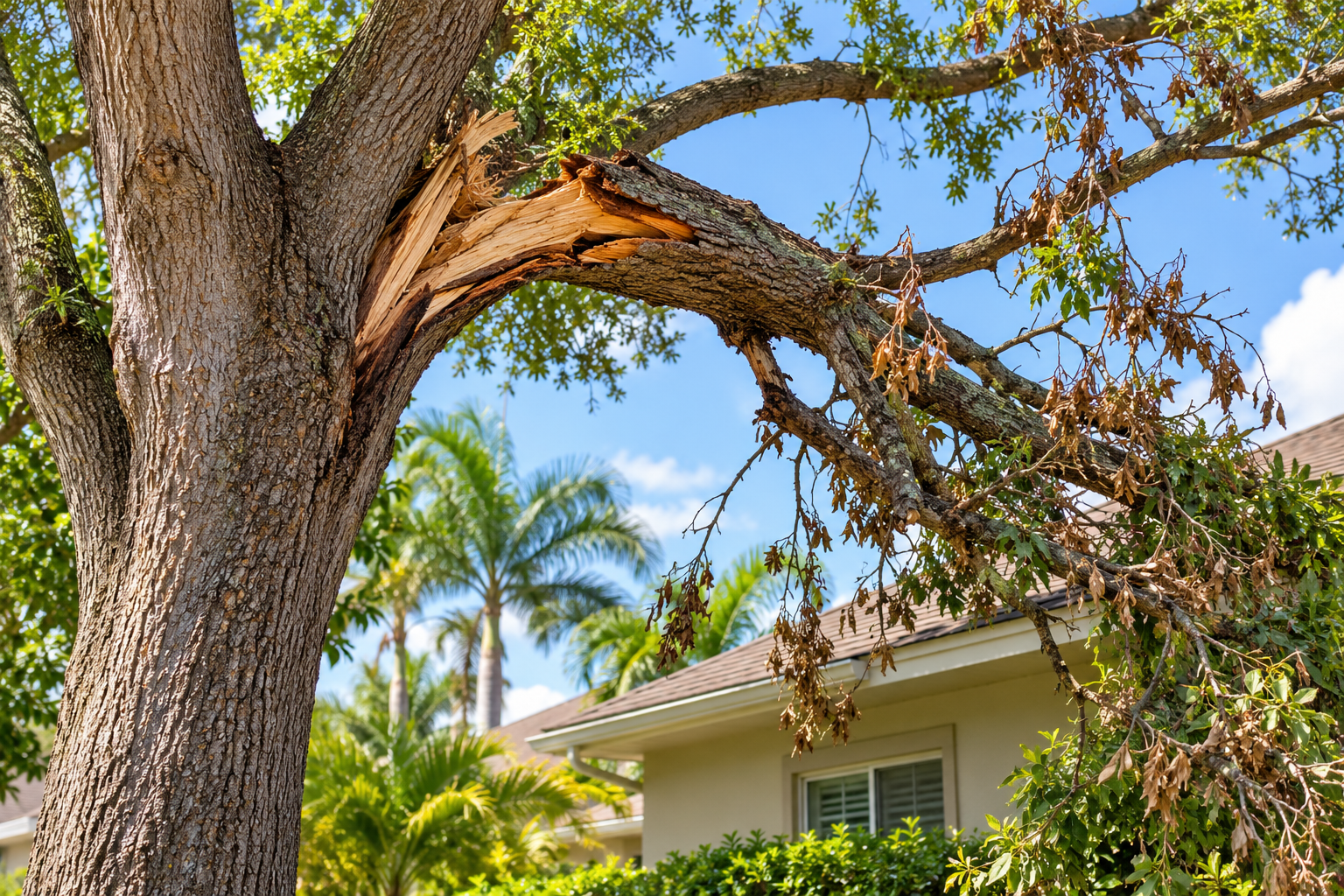
Deep cracks in the trunk or where large limbs meet can indicate structural weakness. Multiple trunks that grow tightly together can also develop included bark, which may create a weaker connection as the tree becomes larger.
Do not try to judge a major split only from the ground if the tree is large. The location, depth and surrounding wood all matter when deciding whether pruning, support or removal should be considered.
A hollow area does not automatically mean a tree will fail, but visible decay is a reason to pay attention. Soft wood, cavities, extensive bark loss or fungal growth around the trunk or root area can be signs that internal wood is deteriorating.
What matters is how much sound wood remains and where the decay is located. A tree professional can evaluate the visible symptoms in the context of the tree’s size, species, location and nearby targets.
Roots are easy to overlook because much of the system is underground. Construction, trenching, driveway work, soil compaction and changes in grade can damage or restrict roots even when the canopy still looks normal.
If major work has recently taken place near a mature tree, monitor it for thinning foliage, dieback, instability or other changes. Root damage can affect both tree health and structural support.
Long, heavy limbs that extend over a roof, driveway or neighboring property can create concern, particularly when the canopy has not been maintained for years.
Professional tree trimming, structural pruning, side trimming or canopy elevation may help manage clearance and remove problematic growth. Pruning should have a clear purpose; removing too much live canopy at once can create additional stress rather than solve the problem.
A tree can look different after severe weather even when it is still standing. Fresh cracks, hanging limbs, newly exposed roots, broken tops or a changed lean are all reasons to inspect the area carefully.
Keep people and vehicles away from obviously damaged trees or suspended branches. Large storm-damaged trees can be unpredictable, and work involving heavy limbs or equipment is not a good DIY project.
Finding a warning sign does not automatically mean the whole tree needs to be removed. Depending on the condition, trimming, dead wooding, canopy work or targeted branch removal may address the immediate concern.
Removal becomes more likely when the tree has serious structural problems, is dead or declining beyond reasonable management, or presents an unacceptable risk to nearby people or property. A site-specific assessment is the best way to determine the appropriate next step.
Brown’s Budget Tree Service provides tree removal, trimming, dead wooding, canopy elevating, stump grinding and 24-hour emergency tree service in Southwest Florida. The company states that it has served the area for more than 30 years.
If you are concerned about a tree near your home or business, contact Brown’s Budget Tree Service for a free estimate and an on-site look at the situation. Confirm the current phone number shown on the website before publishing this article, because existing public pages currently display more than one number.